From custom signage and branded components to precision-cut parts and promotional items, laser cutting and engraving has become one of the most versatile and cost-effective manufacturing tools available to South African businesses. If you have not yet explored what it can do for you, this guide is a good place to start.
What is laser cutting and engraving?
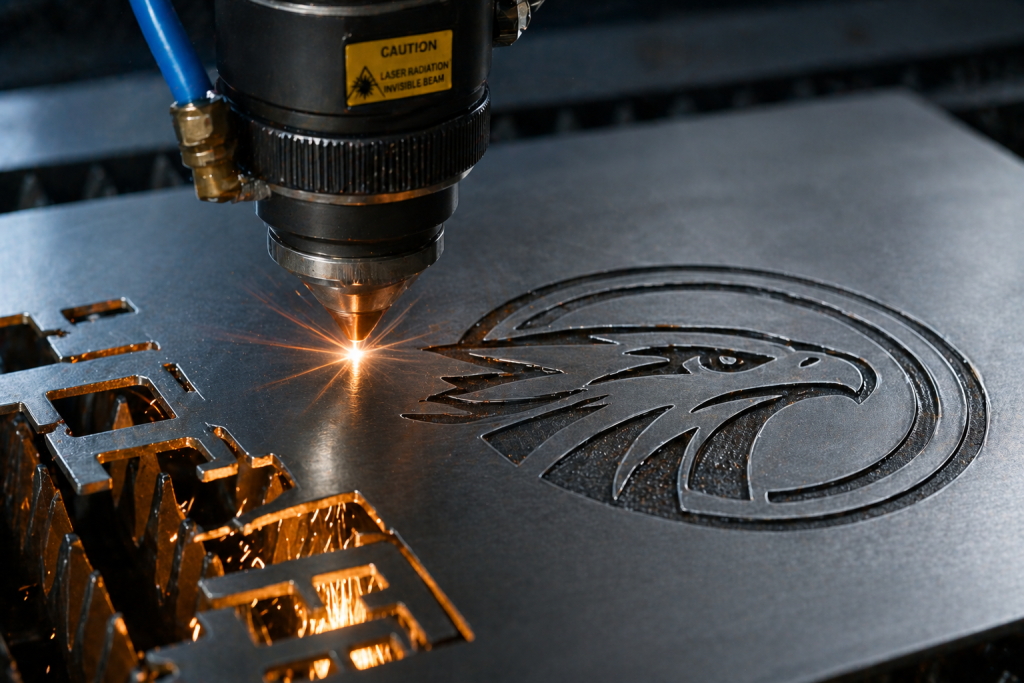
Laser cutting and engraving are two distinct but closely related processes, both driven by a high-powered, focused beam of light. In laser cutting, the beam slices cleanly through a material, producing precise shapes, profiles, and components with very little waste and extremely tight tolerances. In laser engraving, the beam removes or vaporises the surface layer of a material to etch a design, logo, text, or pattern into it permanently.
Both processes are computer-controlled, which means the output is consistently accurate across every single piece produced. Whether you need one custom item or a thousand identical components, the result is the same: clean edges, sharp detail, and a professional finish that manual cutting or printing simply cannot match.
The technology works across a wide range of materials, including mild steel, stainless steel, aluminium, acrylic, wood, leather, glass, rubber, and various plastics. This versatility is one of the key reasons it has become so widely adopted across industries.
Why businesses are choosing laser cutting and engraving
The business case for laser processing is straightforward: you get higher precision, faster turnaround, and less material waste compared to traditional manufacturing methods. For business owners, this translates directly into better margins, quicker lead times, and a more consistent end product.
Traditional cutting methods such as plasma cutting, waterjet, or manual fabrication all have their place, but they also come with limitations. Plasma cutting, for instance, produces a heat-affected zone that can distort thinner materials. Manual cutting requires skilled labour and is harder to replicate consistently. Laser cutting sidesteps most of these issues, delivering clean, burr-free edges with minimal post-processing required.
For engraving specifically, the permanence and sharpness of a laser-engraved mark is unmatched by pad printing, screen printing, or adhesive labels. It does not fade, peel, or wash off, making it ideal for branded equipment, product identification, compliance marking, and promotional gifts.
Industries that benefit most
Laser cutting and engraving is not limited to one sector. Across South Africa, businesses in a wide range of industries are using it to solve real production and branding challenges.
In the manufacturing and engineering sector, laser cutting is used to produce brackets, flanges, panels, gaskets, and custom components with tolerances that meet exacting specifications. The ability to cut complex profiles directly from a digital file eliminates the need for expensive tooling or dies, reducing both cost and lead time significantly.
Retail and hospitality businesses use laser-cut and engraved signage, menu boards, wall features, display stands, and branded furniture elements to create distinctive interior environments. The precision of laser cutting allows for intricate designs that would be impractical or impossible to achieve by hand.
In the promotional and corporate gifting space, engraved items carry a weight and permanence that printed alternatives lack. Laser-engraved pens, awards, plaques, keyrings, and leather goods communicate quality and attention to detail, which reflects well on the brand presenting them.
Construction and architectural firms use laser-cut screens, cladding, balustrades, and decorative metalwork to add visual interest and functional structure to buildings and interiors. The ability to cut highly detailed patterns into sheet metal or acrylic opens up design possibilities that are difficult to achieve through any other process.
Custom parts and components: a closer look
For businesses that rely on custom-fabricated parts, laser cutting offers a significant advantage over conventional methods. Once a design is finalised in a CAD (computer-aided design) file, it can be sent directly to the laser cutter for production. There are no dies to make, no setup jigs to build, and no lengthy lead times waiting for tooling. The part is cut to specification from the first piece.
This makes laser cutting particularly valuable for prototyping. If you are developing a new product or testing a design, you can produce a physical prototype quickly and cost-effectively, review it, make adjustments to the digital file, and cut a revised version the same day. The iteration cycle is dramatically shorter than with traditional manufacturing.
For ongoing production runs, laser cutting delivers consistent accuracy across every piece. There is no variation introduced by operator fatigue or tooling wear, which is a common issue with manual or mechanically driven cutting processes. Each component is cut to the same specification as the last, which simplifies quality control and reduces scrap rates.
Signage and branding: making a lasting impression
Your signage is often the first physical impression a customer has of your business. Laser-cut and engraved signage communicates a level of quality and intentionality that printed vinyl or off-the-shelf boards simply cannot replicate. Whether it is a reception sign, a building identifier, directional signage, or a display feature, the precision and finish of laser-processed signage elevates the perceived value of your brand.
Materials commonly used for business signage include stainless steel, mild steel, acrylic, and wood. Each offers a different aesthetic. Stainless steel conveys a clean, corporate feel. Acrylic allows for backlit designs with vivid colour. Timber brings warmth and a handcrafted quality. Laser cutting works equally well across all of them, allowing you to achieve the look that fits your brand identity.
Engraving adds another dimension to signage by incorporating logos, text, and detail directly into the surface of the material rather than sitting on top of it. This is particularly effective for nameplates, plaques, and branded panels where durability and longevity matter.
What to consider when commissioning laser work
Getting the best result from a laser cutting or engraving job starts with the brief. The clearer and more complete your specifications, the faster and more accurately the job can be produced. Here are a few things to have ready before you approach a service provider.
First, a digital design file is essential. Most laser cutting services work from DXF, DWG, AI, or PDF files. If you do not have an in-house design capability, a good service provider will be able to assist with drafting or converting your artwork into a suitable format. Make sure your file includes accurate dimensions and indicates any fold lines, cutouts, or engraving areas clearly.
Second, specify your material and thickness upfront. Different materials and gauges cut differently, and the right settings on the laser are determined by what you are cutting. If you are unsure which material best suits your application, ask for guidance. A knowledgeable service provider will be able to advise on the trade-offs between cost, durability, aesthetics, and machinability.
Third, be clear about quantities and lead time requirements. Laser cutting is well suited to both small runs and larger volumes, but your production schedule affects how the job is prioritised and nested on the cutting sheet. Providing as much notice as possible ensures you get the best turnaround time and the most cost-effective nesting.
The value of working with a specialist
Not all laser cutting services are equal. The quality of the output depends on the capability of the equipment, the skill of the operators, and the service provider’s ability to understand your brief and translate it into a finished product that meets your expectations. Working with a specialist who has experience across a range of materials and applications gives you access to that knowledge, which can save you time, money, and frustration.
A good laser cutting and engraving partner will also guide you on design for manufacture, flagging potential issues before they become costly mistakes. Things like minimum feature sizes, material grain direction, edge finish requirements, and assembly tolerances all influence how a job should be set up, and an experienced team will raise these questions early in the process.
Get laser cutting and engraving done right with 1Laser
At 1Laser, we work with businesses across South Africa to deliver precision laser cutting and engraving solutions for custom parts, signage, branding, and more. Whether you have a clear brief ready to go or are still working through the details of your project, our team is equipped to help you get the outcome you need. Visit our services page to explore what we offer and get in touch to discuss your requirements.
We understand that every business has different needs, different timelines, and different budgets. Our approach is to work with you to find the most practical and cost-effective solution for your specific application, backed by the precision and consistency that only laser technology can deliver.
Ready to get a custom laser cutting or engraving project off the ground? Explore our full range of services and reach out to the 1Laser team today.View 1Laser services →